- Overview
- Trip Outline
- Trip Includes
- Trip Excludes
- Gallery
- FAQ
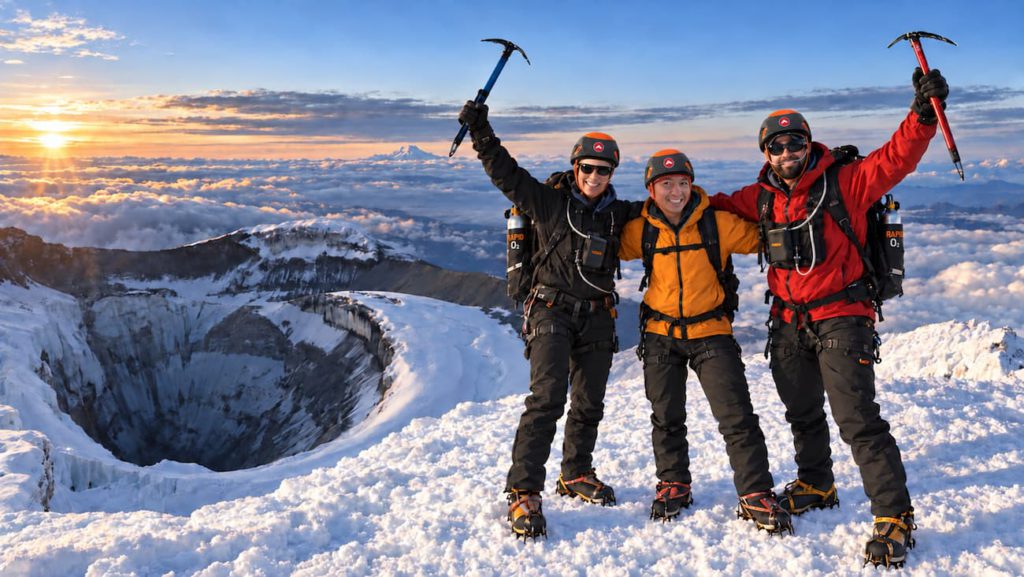
This six-day private expedition is built around one objective: reach Cotopaxi's summit with more physiologic reserve, without turning a short itinerary into a gamble. The program combines progressive altitude exposure, dedicated guiding, continuous field monitoring, and a compact supplemental-oxygen system designed specifically for movement at altitude.
No details found.
Itineraries
Day 1
Arrival in Quito
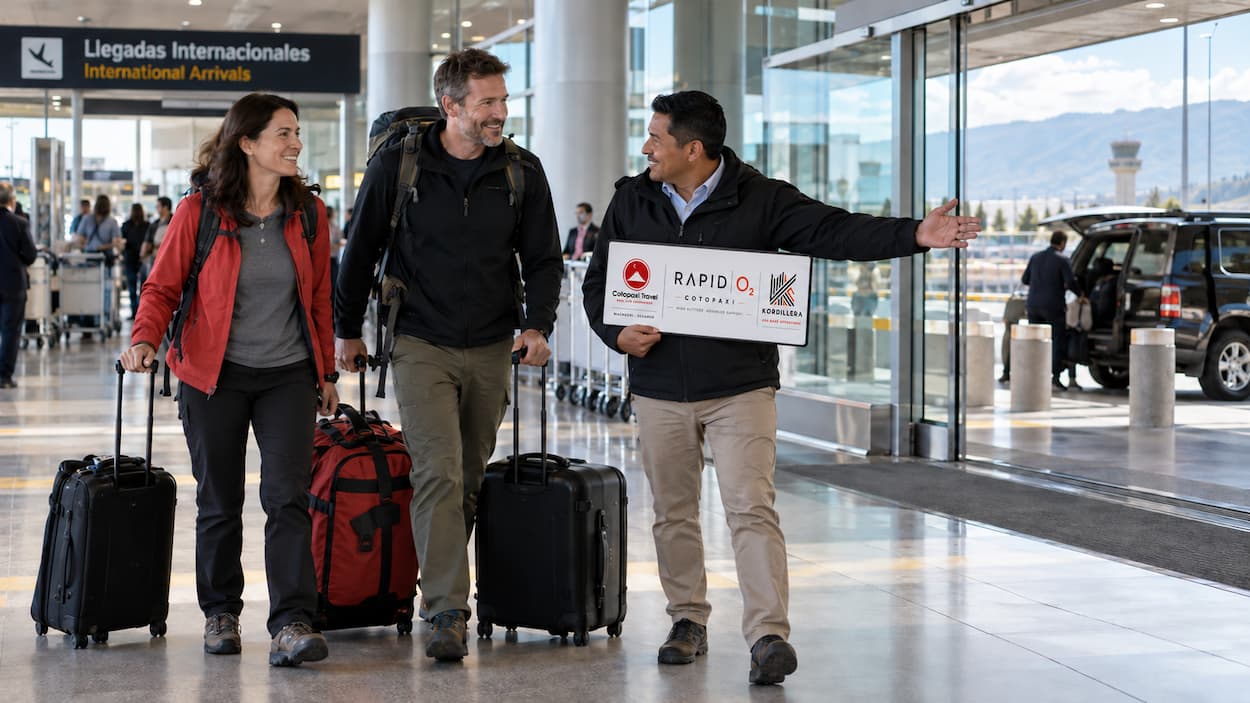
You are met at Mariscal Sucre International Airport and driven privately into Quito. The afternoon is deliberately quiet. At 2,850 m / 9,350 ft, useful acclimatization begins immediately; a gentle walk around the hotel neighborhood is enough.
That evening, the expedition leader reviews the route, oxygen system, safety protocol and turnaround discipline. A physician-designed screening records resting SpO2, heart rate, temperature and blood pressure to establish your baseline for the mountain.
- Altitude: 2,850 m / 9,350 ft
- Accomodation: Hotel in Quito
- Meals: -/-/-
- Distance:---
- Duration:---
Day 2
Acclimatization — Cueva del Oso
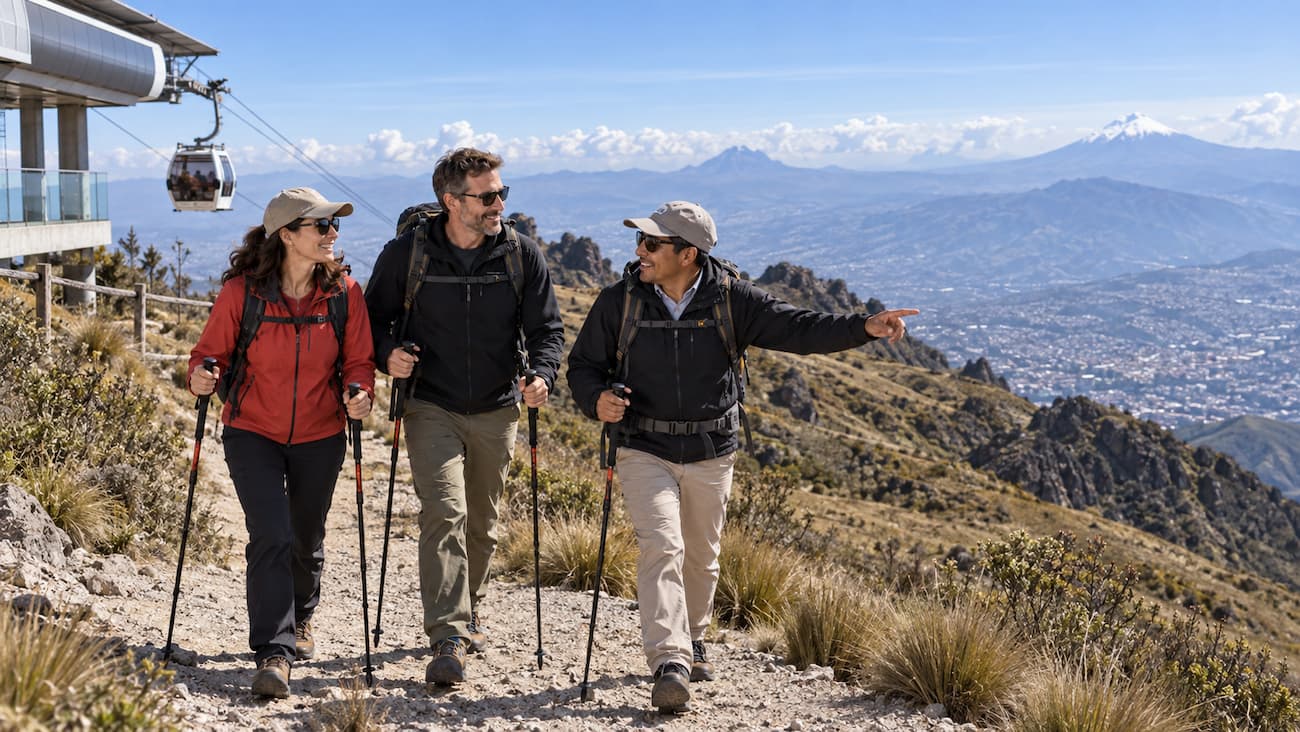
The TelefériQo lifts you to Cruz Loma at 4,050 m / 13,287 ft. From there you walk the ridgeline toward Cueva del Oso, a rock shelter on Rucu Pichincha with Quito spread out below.
Three to four hours above 4,000 m provides a useful ventilatory and physiologic acclimatization stimulus and, equally important, lets the guide observe pace, movement under load, SpO₂, heart rate and temperature. It is not presented as an instant red-cell-mass adaptation; those hematologic changes take longer.
- Altitude: 4,300 m / 14,100 ft
- Accomodation: Hotel in Quito
- Meals: Breakfast/Box Lunch/-
- Distance: ~7 km
- Duration: 4–5 hrs
Day 3
Mountain gear
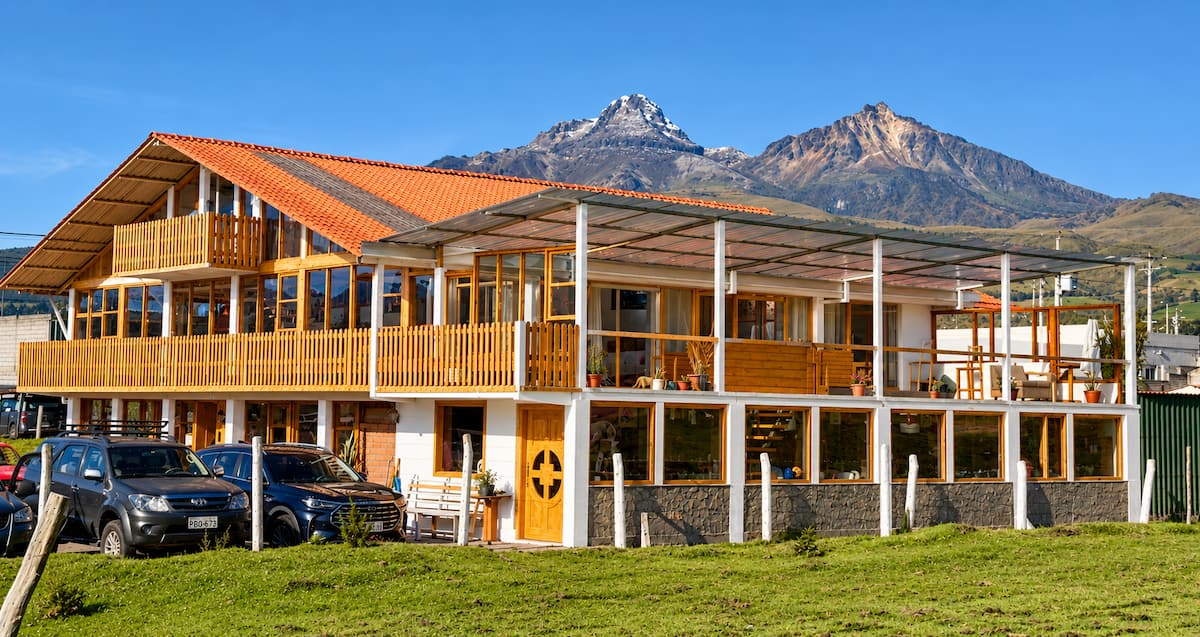
Drive south along the Avenue of the Volcanoes to El Chaupi. At the Ilinizas Mountain Lodge, your technical equipment and Rapid O2 system are collected, fitted and checked. Cylinder pressure, regulator function, cannula, batteries and spares are logged; boots, crampons, ice axe, harness, helmet and outer layers are fitted individually.
You continue to Hacienda Los Mortiños in El Pedregal. Sleeping at 3,600 m is a deliberate acclimatization step before the summit sequence.
- Altitude: 3,600 m / 11,811 ft
- Accomodation: Hacienda los Mortiños
- Meals: Breakfast/-/Dinner
- Distance: ---
- Duration: ---
Day 4
Cotopaxi National Park — Tambopaxi
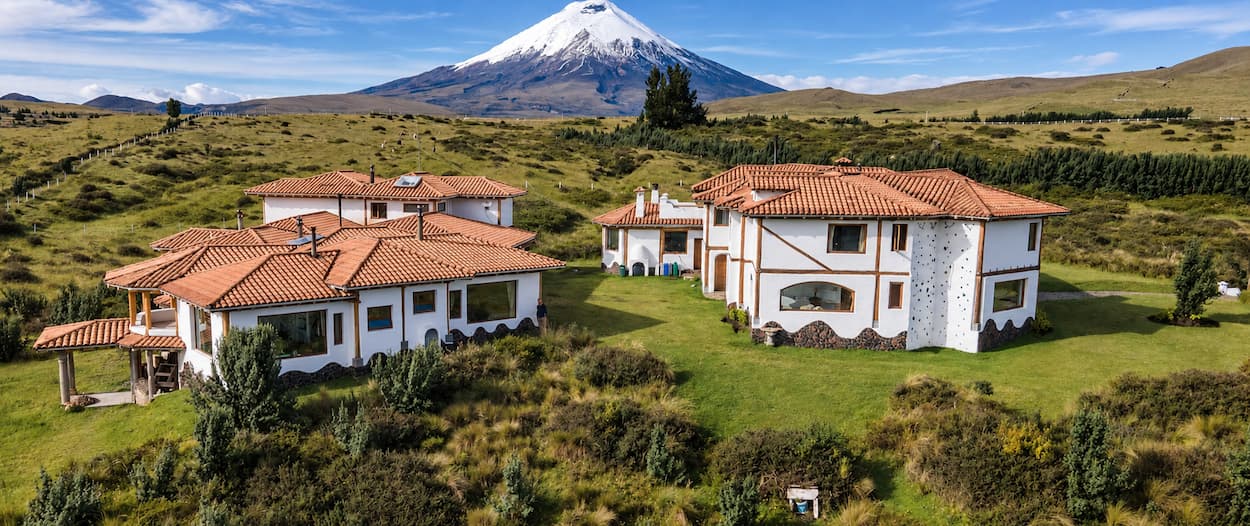
A short drive enters Cotopaxi National Park and reaches Tambopaxi. You walk the high páramo with your assigned two-person mountain team — Lead Guide and Mountain Assistant — at an unhurried pace, with repeat SpO2, heart-rate and temperature checkpoints. The complete Rapid O2 sequence is then rehearsed with gloves on: cannula placement, system start-up, pressure check, battery status and contingency procedures. Your individual oxygen plan is confirmed against the SpO2, heart-rate, temperature and pace response observed across the previous days. Dinner is at 6:00 p.m.; final briefing and medical check follow, with lights out by 8:00 p.m.
- Altitude: 3,750 m / 12,303 ft
- Accomodation: Tambopaxi Lodge
- Meals: Breakfast/Box Lunch/Dinner
- Distance: ---
- Duration: 4–5 hrs
Day 5
Summit Cotopaxi
A private transfer from Tambopaxi reaches the 4,600 m trailhead, followed by the walk to José Ribas Refuge. Rope teams depart on a staggered schedule, each climber with a dedicated ASEGUIM-certified Lead Guide and one Mountain Assistant. Rapid O2 support is used according to the individual plan, via nasal cannula and on-demand delivery with automatic altitude compensation. SpO2, heart rate and temperature are checked at defined physiologic checkpoints throughout the climb.
- Altitude: 5,897 m / 19,347 ft
- Accomodation: Termas de Papallacta
- Meals: Breakfast/Box Lunch/Dinner
- Distance: 12–14 km
- Duration: 9–11 hrs
Day 6
Return home
After an unhurried breakfast and, if time allows, a final hour in the thermal pools, you transfer privately to the airport. You leave with a summit certificate and the complete record of your ascent: altitude profile, SpO2, heart rate and temperature checkpoints, Rapid O2 system settings/status and elapsed times.
- Altitude:
- Accomodation: -
- Meals: Breakfast/-/-
- Distance: ---
- Duration: ---
- ASEGUIM-certified Lead Guide dedicated to each climber on Days 4 and 5.
- One Mountain Assistant per climber for equipment, water, insulation and oxygen support.
- Expedition Leader supervising the operation as a whole.
- One dedicated 425 L Rapid O₂ primary cylinder per climber; shared reserve oxygen and spare delivery components.
- On-demand nasal-cannula delivery with automatic altitude compensation.
- Rapid O₂ field log with SpO₂, heart rate and temperature checkpoints throughout the ascent.
- Two nights in Quito; one night each at Hacienda Los Mortiños, Tambopaxi Lodge and Termas de Papallacta, with meals as listed.
- Private ground transportation throughout, including both airport transfers.
- TelefériQo access and guided acclimatization on Rucu Pichincha.
- Individually fitted technical gear: double boots, crampons, ice axe, harness, helmet and outer shell layers.
- National park entry fees and climbing permits.
- SpO₂, heart rate and temperature monitoring at defined checkpoints.
- Summit Re-attempt Guarantee (conditions below).
- International flights and departure taxes.
- Travel and medical insurance (mandatory).
- Single-occupancy supplement: USD $650.
- Personal base layers, gloves, glacier glasses and socks.
- Formal glacier school (available separately).
- Extra meals and drinks in cities.
- Alcohol.
- Tips and personal expenses.
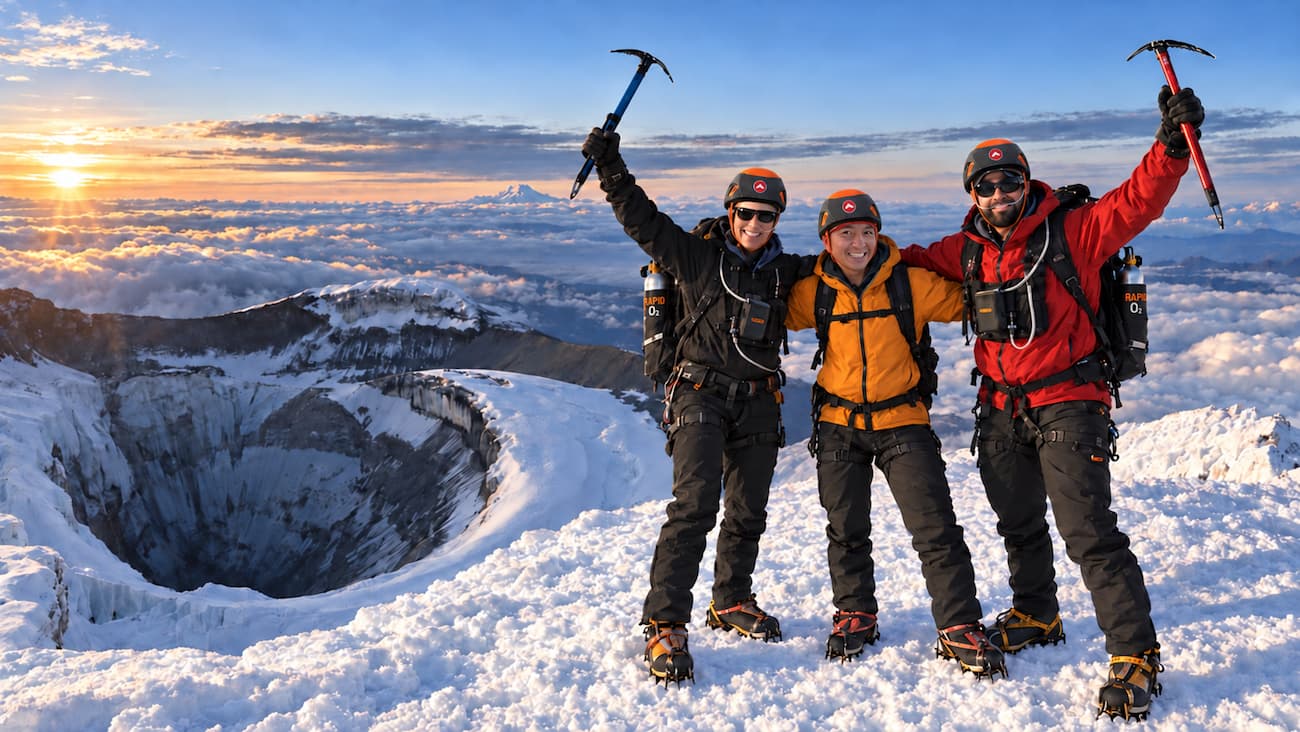
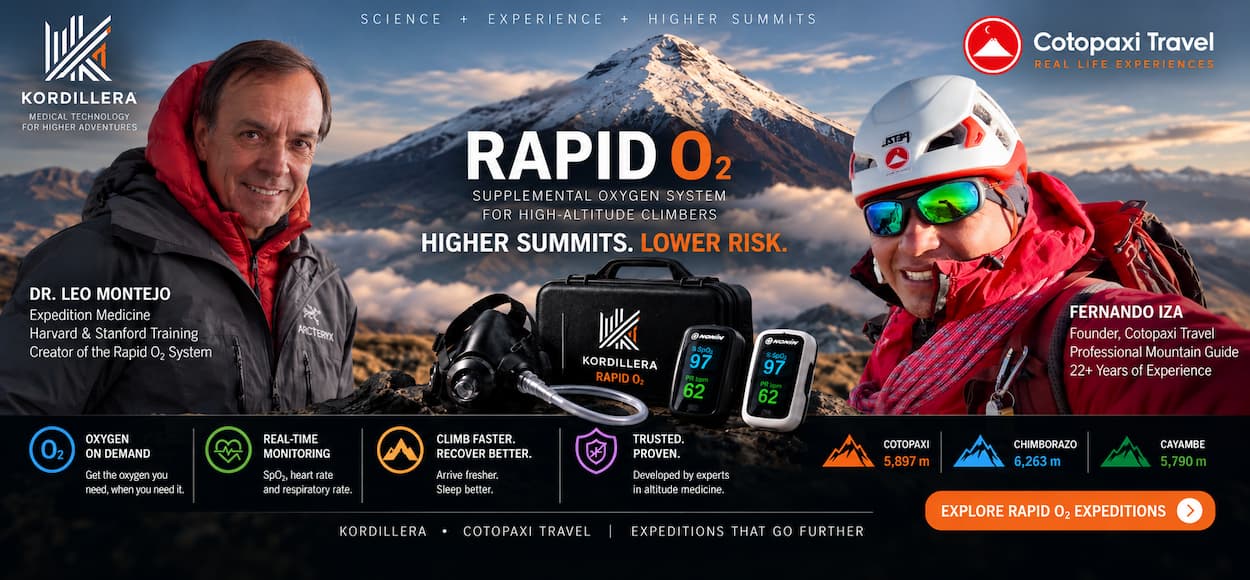
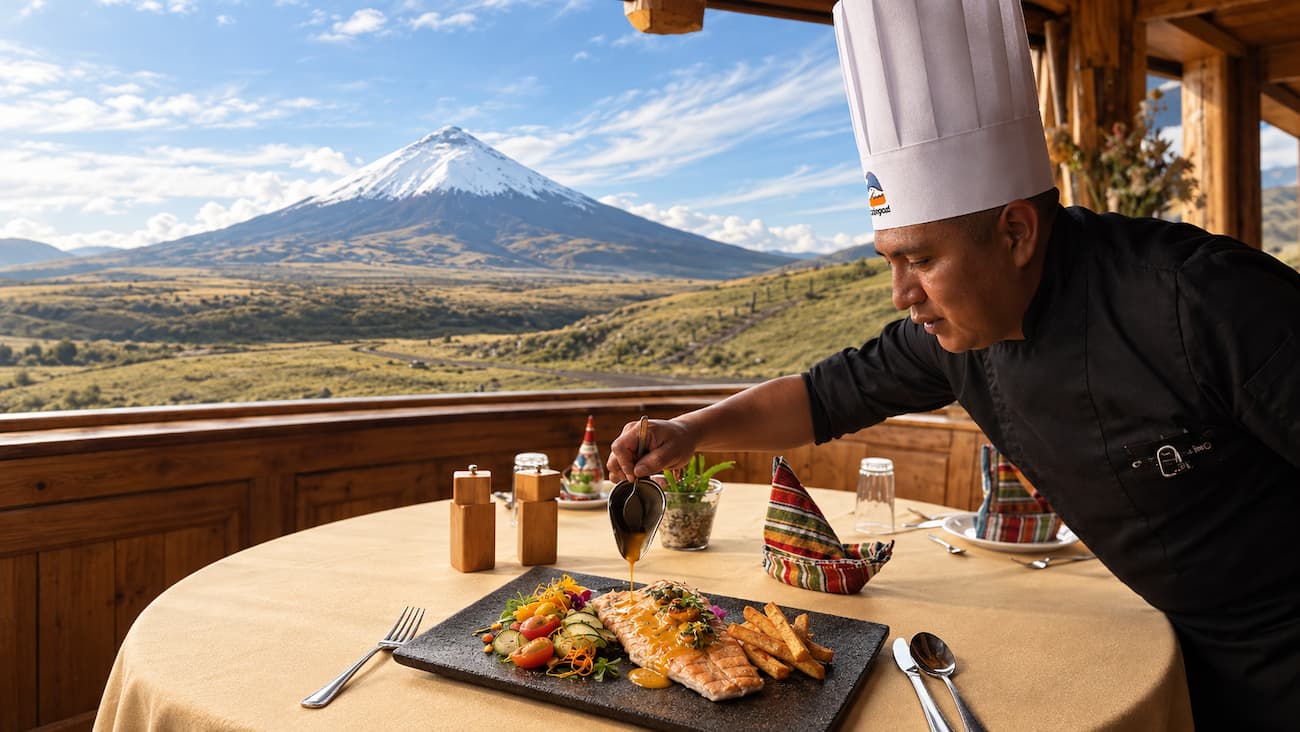
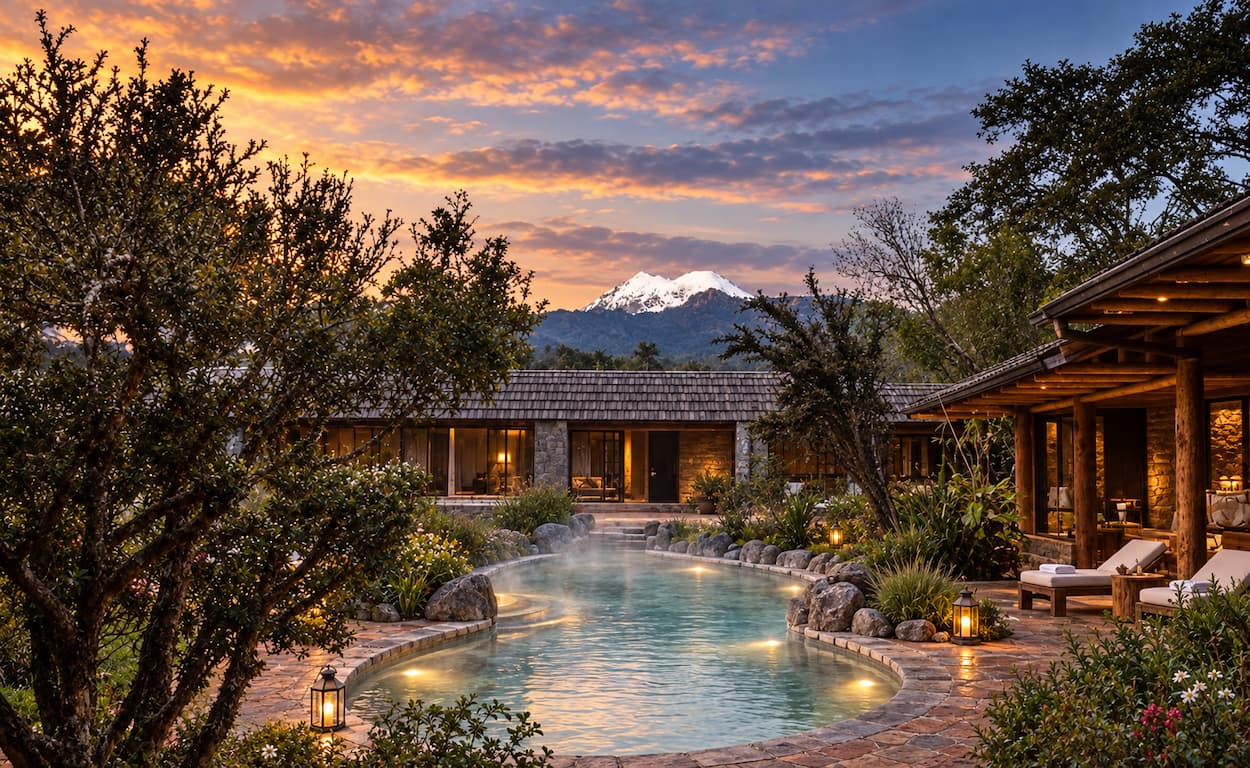
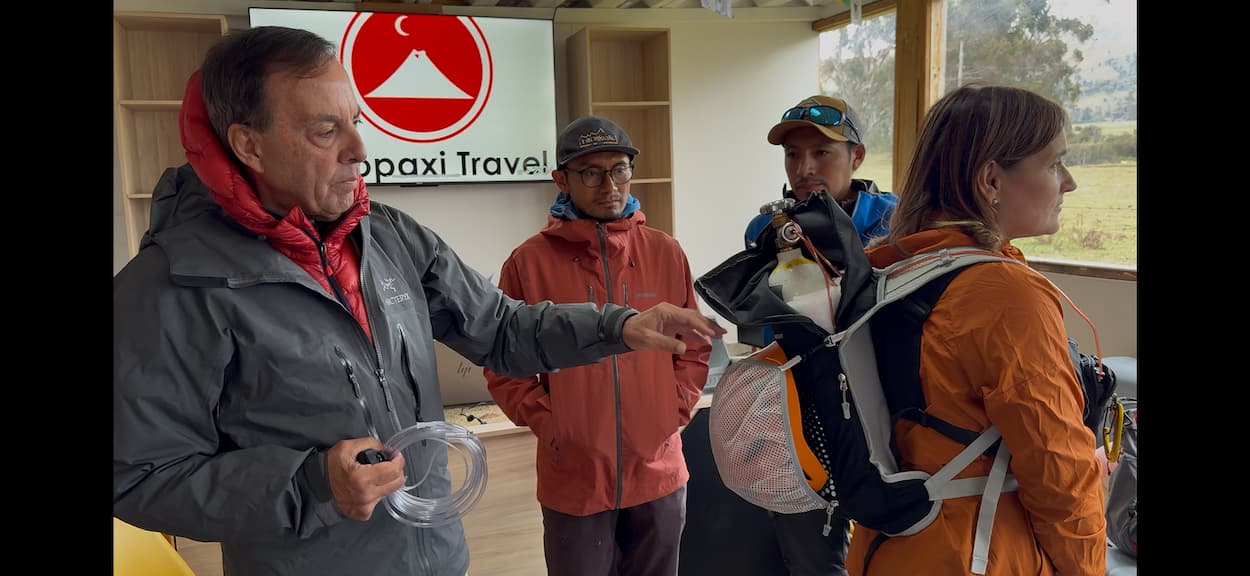
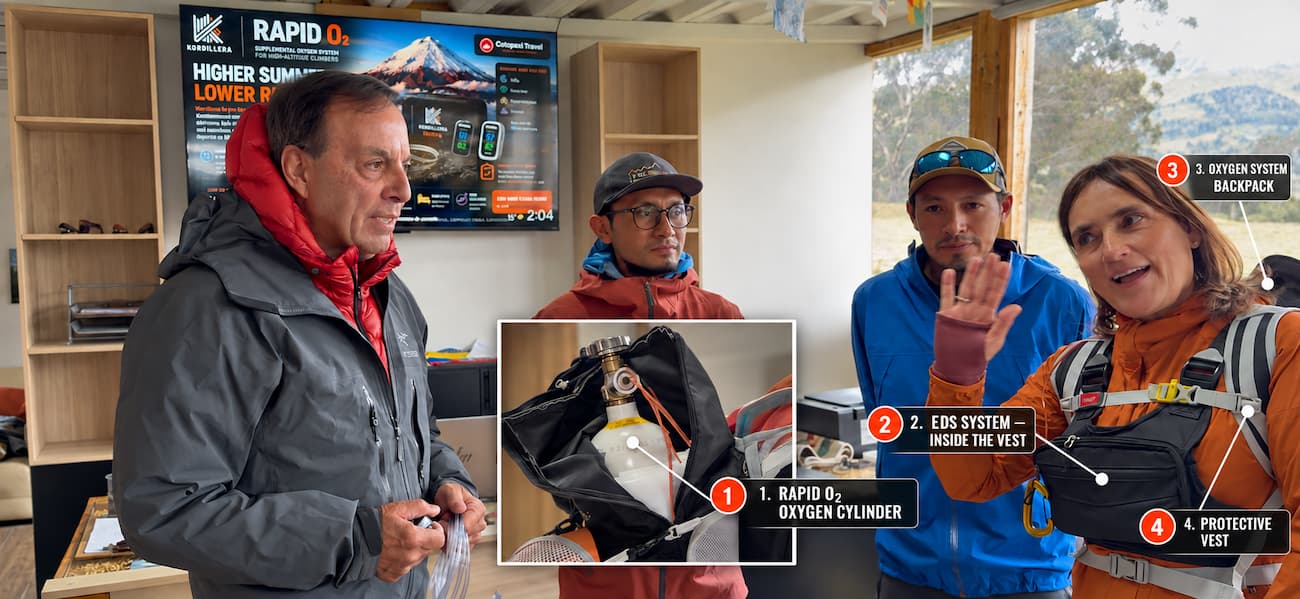
Rapid O₂™ Cotopaxi is a six-day private high-altitude expedition built around one objective: reaching Cotopaxi's 5,897 m / 19,347 ft summit with more physiologic reserve. The program combines progressive altitude exposure, dedicated guiding, continuous field monitoring and a compact supplemental-oxygen system designed specifically for movement at altitude.
Rapid O₂ uses a compact on-demand nasal-cannula system with automatic altitude compensation. Each climber has a dedicated 425 L primary oxygen cylinder providing approximately 12 hours of support, with shared reserve oxygen and spare delivery components available to the team.
No. Rapid O₂ does not replace acclimatization. The program combines controlled altitude exposure with oxygen support to reduce hypoxemia and physiologic strain during the climb. The itinerary includes progressive altitude exposure and two nights above 3,600 m.
No. All climbs remain subject to weather, glacier, volcanic and park conditions. Supplemental oxygen adds physiological reserve, but it never justifies continuing beyond the Lead Guide's safety decision. The absolute turnaround time on summit day is 8:00 a.m.
Participants should be able to walk 6–8 hours with roughly 1,000 m of elevation gain. Previous trekking experience is expected, and prior crampon and roped-glacier experience is strongly preferred. Formal glacier school can be arranged separately.
Each climber has a dedicated ASEGUIM-certified Lead Guide and one Mountain Assistant on Days 4 and 5. An Expedition Leader supervises the operation as a whole.
Rapid O₂ monitors SpO₂, heart rate and temperature at defined checkpoints throughout the ascent. A baseline screening also records resting SpO₂, heart rate, temperature and blood pressure before progressing higher.
If weather, glacier conditions, park closure or a guide safety decision prevents the summit, the climber may return the following season once with the program fee waived; airfare is not included. The guarantee does not apply to voluntary withdrawal or failure to comply with the medical/safety protocol.
Participants should be capable of walking 6–8 hours with roughly 1,000 m of elevation gain. Rapid O₂ provides supplemental support, but Cotopaxi remains a serious high-altitude glacier ascent requiring fitness, endurance and conservative mountain judgment.
The Rapid O₂ Cotopaxi 6-Day Expedition is USD $5,897 per person.
The program includes dedicated guiding and mountain support, a 425 L Rapid O₂ system, physiological monitoring, technical equipment, private transportation, selected accommodation, acclimatization activities, permits and the services listed in the expedition program.